
The unique feature of the Fujifilm X100 Series
I’ll summarize, in case no one has ever heard of the Fujifilm X100 series: these are fixed, non-interchangeable optical cameras.
The 23 mm f/2 is equivalent to a 35 mm in full-frame format. The camera has an unmistakable vintage look, making it feel like a real analog camera.
The physical dials for adjusting the exposure triad—aperture, shutter speed, and ISO—also merit mention. It also has an exposure compensation dial when using semi-automatic modes, such as aperture priority and shutter speed priority.
The camera has three other unique aspects for this category:
- A hybrid viewfinder can be optical / Galilean with a small digital electronic preview.
- A central shutter (which allows a very high Flash synchronization time)
- Including a four-stop ND filter that can be turned on and off at will.
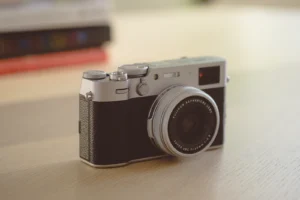
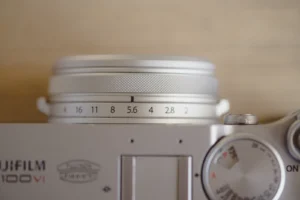
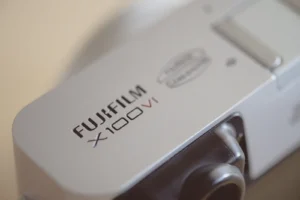
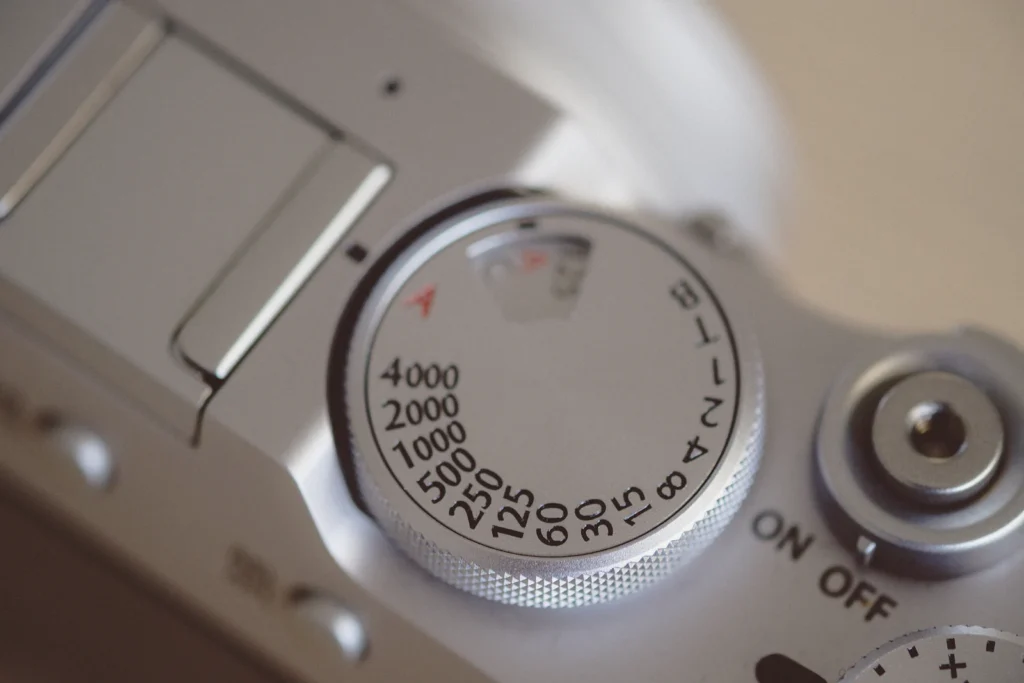
X100VI, My Second Camera In The Series
I want to start by saying that the Fujifilm X100VI is my second camera in the X100 series after the X100T, which I have had for almost ten years. I previously reviewed it in this article (one of the most read on my site!).
I waited a long time to update my X100T, partly because I had the X-Pro 2 camera next to me. Now, I have the X-Pro 3 and the X-T3, X-T4, and X-H2. The X100F and X100V updates were exciting but not too striking for me.

With the Fujifilm X100VI, I have exactly what I wanted: a miniaturized version of my X-H2 (obviously with many more limitations). The two cameras can work together: I find the same APS-C sensor with 40mp of resolution, the same algorithms with AI support for face recognition, the same film simulations (although I look forward to the update of the X-H2 that will bring the Reala Ace simulation to the camera), and also the image stabilizer on the sensor.
On paper, therefore, the X100VI is the perfect camera to carry around. I got it last month: I was lucky enough to find it at a retailer in my city a few days after the presentation, and since they were selling super fast, I didn’t think twice and bought it.
The Camera To Have Always With You
Since that day, the camera has always been with me: it is comfortable to carry the X100VI around and train your eyes to take pictures daily. It was an exciting month for me, during which I found many inspirations from Joel Meyerowitz’s work: I bought his latest book, “A Question of Color” (I will discuss it in detail in a future article) and, thanks to a gift, followed his online masterclass.
I like Meyerowitz’s work regarding everyday life, street photography’s inspiration, and the ability to find visual and photographic interest even in seemingly trivial things.

The Aesthetic Of The Fujifilm X100VI
From the camera’s stylistic point of view, I compared it with my previous X100F and noticed many changes: the shapes are a little sharper and more angular. The silver X100VI’s finish is more matte than my previous X100T, and I must say that at first, it felt more like plastic than the X100 T’s finish.
The upper shell of the camera isn’t made of real metal; it’s painted plastic with this matte silver finish.Note: As mentioned in Maximus’ comment, I’ve also checked online, and Fujifilm states that the top plate is “Aluminum.” Well, it’s good to know. I’m almost sure that the X-T3 and X-T4 I had instead were just plastic with silver paint.
We will have to see if the new camera will stand the test of time: my previous X-T3 and X-T4 have shown obvious signs of use on the upper shells, despite always being stored in bags or backpacks.


What’s New On The X100VI From Previous Cameras
The biggest leap in this camera is the sensor, autofocus, and image stabilization.
The sensor is the same 40mp sensor found on the X-H2 and the X-T5.
This sensor’s yield is excellent; even at the highest ISOs, the noise is always relatively low (I rarely shot higher than ISO 6400).
One of the features I’ve used most in the last month with the Fujifilm X100VI has been digital cropping, which lets you get a 50 mm at 20 MP resolution or a 70 mm at 10 MP resolution. The nice thing is that you can set your focus ring as the teleconverter, making it “almost” like a zoom.

I find this feature fascinating because, in practice, it’s as if I always have three additional lenses with me.
Especially the 50 mm at 20 mp resolution is not so far from an X-Pro 2 with 24 mp or the X-Pro 3 with 26 mp.

The 70 mm to 10 MP file is also very usable. I remember that my first DSLR was the 6mp Pentax ist*D, and then I used the Pentax K10 and Canon 40D for many years, which had 10 MP sensors. I did many of my first jobs with these cameras, even weddings. We are now spoiled by these very high resolutions, and we forget that final resolution only matters based on the output of our photos.
I feel that the days when we need the extra optical teleconverter are gone. I remember purchasing the previous TCL-X100 teleconverter and reviewing it some years ago.
Honestly, I didn’t use it so often and was reselling it. I found it quite tedious to screw it on and off to get the equivalent of a 50 mm lens. But those were other days, since my X100T has only 16 MP of resolution!
New Autofocus On The Fujifilm X100VI
Another big feature of the Fujifilm X100VI is its new AI focusing algorithms.
These were introduced with the new X-Processor 5, present from the X-H2s onwards, and have now been brought inside the X100VI.
These algorithms help a lot with focus, especially when recognizing subjects facing the camera. For my kind of photography, I tried face and eye recognition algorithms and consistently got excellent results.


However, the problem remains linked to the lens’s speed of action, which I still find a little slow. On the one hand, AI algorithms quickly identify subjects, but on the other hand, moving the lens to that point of focus is still relatively slow. I think this is due to the camera’s technical limitations. I would love a lens redesign with a linear focus mechanism for the next iteration.
New Film Simulation: Reala Ace
Reala Ace is the latest film simulation introduced by Fujifilm for the medium-format GFX 100 II.
This is the first time this film simulation has been introduced on a camera with an APS-C-type sensor. However, Fujifilm has announced that all current cameras with X-Processor 5 will be updated and will receive this new film simulation in the future.
How to describe this new “Reala Ace” simulation? Fujifilm’s website refers to it as “true-to-life color reproduction and a hard tonality.” I found this simulation brilliant: deeper blues but lighter yellows. Red is well-balanced with the right punch.
I’ve noticed the black tends to be a bit “lifted” even with strong contrast, so it gives that analog vibe when you usually try to lift the shade a bit.

However, I want to highlight an essential point about these film simulations: the color results depend heavily on the photograph’s exposure and, above all, on the white balance you set.
If I take an overexposed photo, I will have more pastel colors. If I shoot underexposed, the color tones will be more intense. If I vary the color temperature to warmer tones, the colors will also be warmer.
So, in addition to choosing the film simulation you prefer, it will be essential to find the correct white balance and do exposure tests to notice the differences between the colors (I remember that these tests can be carried out quickly with Fujifilm’s free software, X-Raw Studio).
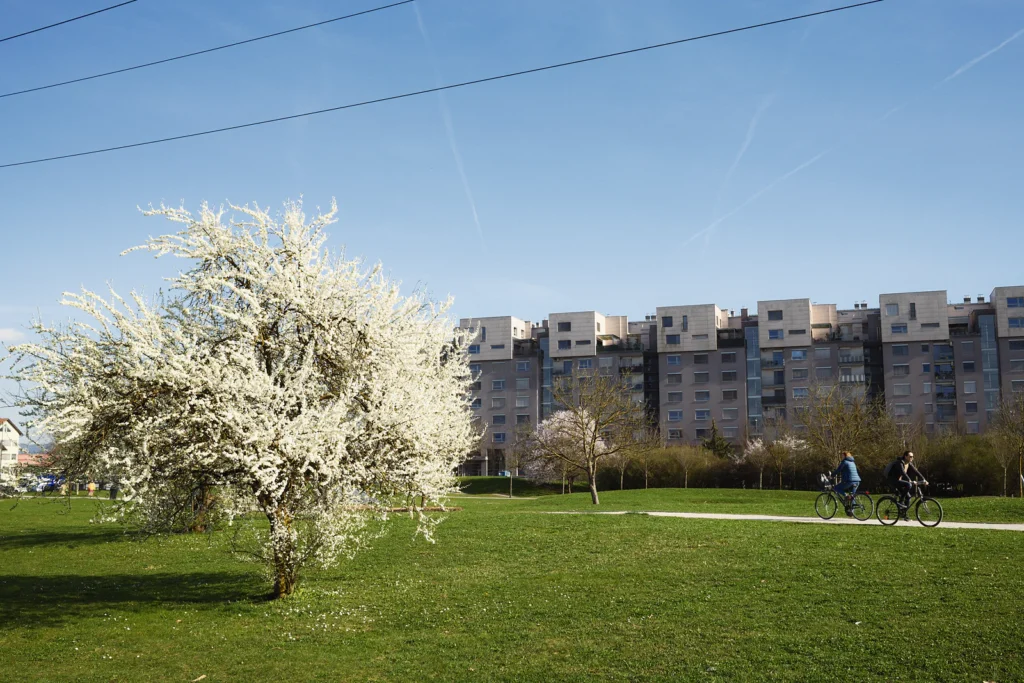
Bonus: My Reala Ace Recipe
I will briefly recap the world of Fujifilm digital cameras for those unfamiliar with it.
Over the past 10+ years, every Fujifilm camera has included film simulations developed directly by Fujifilm engineers.
It’s about reproducing the look and feel of iconic films as faithfully as possible. This concept was born online, especially starting with Fuji X-Weekly, which shares the setup used to obtain a certain color and film look and feel. To achieve this, you will change the camera parameters, usually in the camera’s I.Q. menu under photography settings.
I want to share my adjustments for the new Reala-Ace simulation with you. My goal was to achieve more definition and saturation between the colors.
AM | Reala Ace 2024_01
(This setting currently works only on Fujifilm X100VI and GFX 100II )
- Film Simulation: Reala Ace
- Grain Effect: Off (I prefer to add it in after)
- Color Chrome Effect: Off
- Color Chrome Fx Blue: Strong
- Smooth Skin Effect: Off
- White Balance: Auto Ambience Priority R:1 B:-1
- Dynamic Range: Auto (note: to make this work, you have to set your ISO higher than 160 or use Auto ISO)
- D Range Priority: Off
- Tone Curve: H + 1, S + 1
- Color: +3
- Sharpness: -2
- High Iso NR: -4
I mainly use the HEIF file format, which allows me to save more data at less compression than JPG.







What I Dislike
Like every camera and tool, no one is perfect. Currently, what I dislike:
- The top plate finish construction. As mentioned above, I’ve recently discovered it’s aluminum, but I preferred the magnesium finish of the previous X100T.
- The AI focus algorithms are fast, but the lens has the same previous speed when moving to the point. So, it is slower than the other 23 mm lens on the X-Series camera.
- I would love a second slot for card backup, even if they used the Micro-Sd, as Nikon did with the Nikon Zf camera.
Points I Will Cover Shortly
Battery Life / Electronic & Optical Viewfinder / Button Customization / Movie Quality / Jpg vs Heic / The X-Raw Studio Program.
If you have any other questions, feel free to ask me in the comments, and I will answer them and update the review.







Equipment used in this article
For those most curious about the photo/video equipment I’ve used in this article to produce the photos above, here’s a list with referral links to help the business. Thanks for your support! ❤️



Leave a Reply